

Sustainability
The LEED® Platinum certified Oregon Convention Center should be your first choice for sustainable meetings and events. Every event is already green just by being here!


Sustainability isn’t just a goal; it’s woven into the fabric of what we do at the Oregon Convention Center. As a LEED® Platinum–certified venue, OCC delivers sustainable events by combining solar power (generating over 25% of our electricity), top-tier waste diversion, innovative water stewardship through our rain garden, and a strong focus on equity, diversity, and community collaboration.
We’re also proud to be the only U.S. convention center to attain Platinum certification under the Events Industry Council’s Sustainable Event Standards—affirming our leadership in green venues and socially responsible event management.

Sustainability Achievements
2025 - Received Platinum Events Industry Council (EIC) Sustainable Event Standards Certification
2023 - Recertified LEED® Platinum
2019 - Recertified LEED® Platinum
2014 - We earned LEED® Platinum, the highest certification.
2008 - Recertified, this time achieving LEED® Silver classification.
2004 - Became the first convention center in the world to earn LEED® certification.
Saving Energy
4 charging stations for electric vehicles
100% renewable energy offsets for electricity and natural gas
80% of lighting fixtures upgraded for efficiency
6,500+ solar panels installed, one of the largest solar power arrays on a U.S. convention center
25+% of the facility’s electricity produced by solar power
Recycling and Waste Diversion (2024)
69% of all materials diverted from the landfill
278 tons of materials diverted from landfill through recycling, composting, and donation combined
87 tons of food scraps diverted from the landfill by composting alone
55,536 single-use items diverted from landfills through Bold Reuse program
3,091 pounds of waste diverted from landfills through Bold Reuse program
Saving Water
100% bathroom fixtures upgraded for water efficiency
1,221,180 gallons of estimated water saved annually
Community Engagement (2024)
32,080 pounds of reusable goods donated to nonprofit organizations
5,600 meals donated to nonprofits working to address food scarcity in the Portland area
Annual Sustainability Impact Statements
See how our sustainability story unfolds year by year. Our annual statements show how far we’ve come—and where we’re headed next. Click below to explore past reports and see our progress in action.
Sustainability at OCC
-
LEED Platinum Certification
The Oregon Convention Center has long held a leadership role in green building and other environmentally responsible business practices. In 2004, we were the first convention center to earn the U.S. Green Building Council's Leadership in Energy and Environmental Design (LEED®) for Existing Buildings certification. In 2008, the facility was recertified at the silver level. In 2014, we reached our biggest milestone by earning LEED® Platinum, the highest level of certification, and did it again in 2023.
-
Events Industry Council (EIC) Sustainable Event Standards
We are also the only convention center in the United States to have earned a level 4 APEX/ASTM certification (now EIC Sustainable Event Standards), the first standards created specifically for green meetings and events. This program, verified by the Events Industry Council, gives us a roadmap for planning sustainable events, helping vendors and guests practice green habits, and working with our community to support the environment.
To achieve these accomplishments, we have focused on innovation in the following areas:
Enacting energy reduction projects.
We are always looking out for the next opportunity to improve our energy performance. There’s no project too small to be worth our while, or too big to be undertaken. If it results in energy savings for our building, OCC wants to hear more about it! If you’d like to read more about it, you can here.
Diverting materials away from the landfill.
We have a long-term goal of reaching at least a 70% waste diversion rate, which can only be achieved if we ensure that the material brought into the building can be recycled, donated, or taken back by the company that produced it. We’ve done this by creating extensive waste recycling, composting, and food and reusable material donation programs, working in partnership with many local nonprofit and community assistance organizations. Our streamlined procedure for separating out material streams results in more efficient recycling. Find out more about our Waste Diversion Policy here.
Prioritizing watershed stewardship.
A mix of stormwater management and water conservation helps to protect Oregon’s rivers and streams. These are actions taken in the day-to-day choices that we make in our venue as well as in the decisions we make when maintaining and updating our building. Whether it is our famous rain garden filtering particulates out of the rainwater falling on 5.5 acres of our roof before it gets to the Willamette River, or the gentle nudge of a guest toward one of our 19 water bottle filling stations, we are committed to treating one of the globe’s most important resources with care. Read more about our work here.
Maintaining excellent indoor air quality (IAQ).
Our environmentally-friendly cleaning policy complements the integrated pest management and the no-idling policy on the loading docks. We know that this is just as important for our guests as it is for our employees, so we keep our spaces conditioned to prioritize our IAQ.
Expanding community engagement.
We are always looking for more ways to donate time and resources to Oregonians in need. And to help our clients do the same. Partnerships are key to our success, and we will continue to work with our clients and community on developing the most beneficial and innovative programs. Find out more about what being part of the community means to us here.
Committing to sustainable purchasing.
We know that the largest portion of our carbon footprint comes from our supply chain. And as part of a regional government working to make life better for residents both today and in the future, we are opting for small and local when it comes to purchasing.
Minimizing food waste and waste generation.
We know that recycling and composting is only part of the story. Most of the environmental impacts of food and materials (pollution, habitat degradation, and climate impacts) come from their production and transportation, rather than their disposal. We are working on upstream efforts to reduce food waste and single-use disposable items at our venue. Read more about our partnerships with Path Water Bottles and Bold Reuse.
Sustainable Transportation
How our attendees get to our venue matters, and here in the Pacific Northwest we are proud to provide easy ways to get to our facility smoothly and sustainably. Being right by Trimet’s MAX and bus line, as well as the streetcar provides easy ways to travel to the OCC. We also have ample bike parking and electric vehicle charging stations available for attendees and guests.
It is dedication like this that has resulted in the Oregon Convention Center gaining the reputation of being a leader in the sustainable events movement.
-
We're solar powered
Oregon Convention Center features one of the highest-producing solar panel arrays ever placed on a U.S. convention center. The solar array generates more than 25% of all electricity used at the facility, and the 1.8 million kWh it produces could power 166 average American homes.
Using this clean energy helps the convention center keep an estimated 1,598 tons of CO2 out of the atmosphere each year, which is the amount of pollution created by driving a typical gas-engine car for 3,784,488 miles—or 16 trips to the moon!
The solar array is owned and operated by Tesla, which was awarded the project through a competitive procurement process. Funding for the collaborative project included a $500,000 grant from customers of Pacific Power’s Blue Sky renewable energy program and a $200,000 grant from the Energy Trust of Oregon.
-
Waste diversion

We have a long term goal of reaching at least a 70% waste diversion rate, and this can only be achieved if we ensure that the material brought into the building can be recycled, donated, or taken back by the company that produced it.
The events industry generates a tremendous amount of waste. Historically, there has been very little concern for the environmental and social impacts of convention centers, and industry norms have been established that prove difficult for events professionals to break. The “This is the way we’ve always done it” mentality, combined with different recycling/composting opportunities in various parts of the country, has made it hard for professionals in our line of work to shift the industry in a more sustainable direction.
The Oregon Convention Center is not satisfied with the status quo. We have stepped forward as a model of an alternative way of doing business. Here’s how.
OCC is the only convention center in the country to explicitly call out a formal partnership between client and venue when putting on a sustainable event. We call it our Waste Diversion Policy (WDP), and it is written into the contract so that each stakeholder knows all about the important role they play.
Our Waste Diversion Policy has four main components:
- We identify certain items that are not allowed into the facility. Examples include foam-core signage and single-use plastic bags commonly distributed at trade show events. Items have been put on this list because they are not recyclable in the Pacific Northwest, but alternatives that meet the same need can be recycled.
- A second list includes items that are allowed in the facility, but that must be taken away at the completion of the event. The list includes vinyl banners, wood pallets, electronics, and carpet. This list was designed to help clients find opportunities for reuse.
- The third expectation of the Waste Diversion Policy is that all recyclable materials generated over the course of an event are placed in the appropriate receptacles.
- Materials currently collected are:
- Styrofoam
- Cardboard boxes and signs
- Construction debris
- Glass containers
- Kitchen grease
- Paper
- Plastic film and shrink wrap
- Vinyl tablecloths
- Metal containers
- Scrap metal
- Wood
- Food scraps (for composting)
- Plants, trees, and other yard debris
- Materials currently collected are:
- In many cases, there are items at the end of an event that can be donated to local nonprofit organizations. The OCC asks that coordination take place prior to the conclusion of the event. This will allow plans to be put in place that will allow for donations to get where they can be best utilized.
For more information, please feel free to reach out to either the sustainability coordinator or your designated event manager.
-
Energy reduction
Our facilities maintenance team doesn’t sit still. We're constantly looking at ways to innovate and improve efficiency, so there is always a list of projects we're working on to help reduce our energy consumption.
Our energy reduction projects
Energy-efficient air handlers
Many of the air handlers on the original side of the facility run at 100% fan speed at all times due to the type of motor driving them. OCC has replaced fan motors that are able to be driven by a Variable Frequency Drive (VFD), which allows the fan speed of the motor to be driven on the conditions of the space. This fan speed is often less than 50%. OCC proposed a project to replace the supply and return fan motors and add VFD’s to five separate air handlers. The total project cost was roughly $70,000. The work would not have been pursued without the incentive grant from the Energy Trust of Oregon for nearly $41,000, and a grant of $11,000 from the Metro Sustainability Committee. The result is a completed conversion to VFD’s on five air handlers that will cost OCC $18,000. The project will pay for the $18,000 investment in a little over a year through energy savings.
Interior lighting fixture upgrades
32-watt T8 lighting fixtures are currently being upgraded in the hallways behind our exhibit hall spaces. Approximately 400 lights will be changed out to 11-watt non-ballasted LED fixtures.
LED spire and crescent lighting
We installed a new LED lighting system in our iconic glass spires that uses less than half of the energy of the former lights. The programmable system also allows the towers to glow in various colors to reflect the branding of an event happening inside and for public observances.
Transcript for Oregon Convention Center's Energy-Efficient, Programmable Tower LightsClick '...more' in the video description on YouTube, then click 'Show transcript' -
Watershed stewardship
We’re proud to serve as an example of how natural, sustainable practices can be used in urban areas. Even better, we are helping to protect local fish and wildlife from chemicals and other pollutants.
Storm water management

Every year in Portland, approximately 10 billion gallons of rain falls upon hard surfaces like streets, parking lots, and rooftops. Most of these surfaces are impervious—they don’t allow water to soak through. That means that pollutants wash away with that storm water, straight into our streams and rivers. For us, that just doesn’t sit right. We love Portland for its lush landscape, dramatic downpours and thriving wildlife. To exist in harmony with these natural elements, we’ve planned carefully.
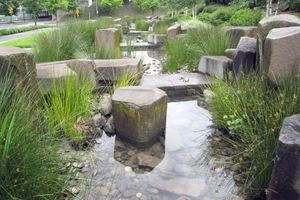
We have a rain garden that channels storm water from 5.5 acres of our roof and reduces the pollution in that water before it gets to the nearby Willamette River. Water flows through piping down through our building and cascades out of four scuppers into a series of nine shallow, narrow pools. The pools are separated by basalt weirs, which allow the water to plunge approximately 18” into the successive pool. The channel of pools is rock lined, and the edges are planted with native plants that will help to filter out sediment. The lower end of the rain garden forms a larger pool.
Storm water also enters this lower pool from a swale flowing from the north. This storm water runoff is from our loading dock. First treated with an oil-water separator, the water then flows 150 linear feet through a vegetated swale into another siphoned inlet, and then into the garden pool.
Water level in this lowest pool is controlled by the grate elevation of the final outlet. From this outlet, the storm water enters a 30-inch storm drainpipe, which is separated from the combined sewers. The pipe discharges the “treated” water into the Willamette River, just a few hundred feet to the west.
Salmon-Safe certified
The Pacific Northwest is home to most of the last wild salmon in the country, according to the nonprofit Salmon-Safe. When our water is clean, native salmon can thrive. In 2007, OCC became the first convention center in the United States to earn Salmon-Safe certification. This recognition is the blue-ribbon standard for urban and agricultural watershed protection.
This Portland-based nonprofit Salmon-Safe works with public and private landowners to promote reduced water use, onsite storm water treatment, and protection of water quality Properties like OCC are certified as Salmon-Safe for extensive efforts to halt runoff from entering streams and impacting imperiled salmon.
Our rain garden, as well as green cleaning choices and pest management practices, played a large part in our certification. Of course, we are also committed to strict water conservation, such as the use of low-flow fixtures and native, drought-tolerant plants.
-
Community engagement

We operate with a pledge to continually reduce our environmental footprint, and to educate staff, clients and visitors on the importance of working together toward a sustainable future.
Achieving LEED® Platinum, EIC Sustainable Event Standards, and other sustainable certifications is more than a point of pride.
It’s a reflection of our community’s values.
The people who live here have always celebrated a cleaner, healthier environment and sustainable communities. OCC is located in the heart of Portland and has helped the city to establish an international reputation for sustainability. And the city government itself, with a strong commitment to sustainability, helps reinforce these important values through practice and policy for both residents and guests of the region.
And of course, we do everything in our power to build community within our very own walls. Employee engagement activities. Client outreach. Even our focus on supporting woman and minority-owned businesses with our purchasing choices. Our $35 million renovation project, for example, is the largest public contract ever awarded to a minority-owned business in the state of Oregon’s history. The OCC knows that this is a team sport, and supporting the residents of our region is a top priority.

Sustainable Communities
For us, “sustainability” is about much more than just the environment. The ultimate goal should be a safe and healthy place where all people can work, live, and grow. So it is no small feat that the OCC helps to maintain about 6,000 jobs in the Portland region, and attracts an estimated $625 million of economic impact annually.
OCC falls under the umbrella of Metro, the unique, regional government in the area. Overseen by an elected council, Metro helps to plan and coordinate land use and development decisions, protect natural spaces in the area, manage waste and recycling programs, and create policy that protects the health, well-being, and happiness of residents.
Lloyd EcoDistrict
The OCC is in the center of Lloyd, an EcoDistrict working to become the most sustainable neighborhood in the country. Through a nonprofit, and with the help of businesses like the Oregon Convention Center, Lloyd is working to achieve ambitious goals in areas such as waste reduction, climate action, and community resilience. The OCC is proud to support Lloyd EcoDistrict monthly cleanup events and other community initiatives. We are lucky to have such great neighbors!
Sustainability Partners
The OCC knows the importance of partnership. We work closely with a variety of businesses, government organizations, and environmental nonprofits to ensure that our air, land, water, and people are treated with care. Our partnerships and certifications help ensure we are always leading the way in innovative solutions and initiatives.
- Bold Reuse
- Compass Group and Levy
- Energy Trust of Oregon
- Events Industry Council
- Metro
- Pacific Power Blue Sky Renewable Energy
- Salmon-Safe
- SmartEnergy
- Telsa
- U.S. Environmental Protection Agency Green Power Partnership
- U.S. Green Building Council and LEED
- The Wave Foundation
We know quality donations are critical to local nonprofits who help lift up our neighbors and community. Here at OCC, we don't want to see anything go to waste. That’s why we work with event clients to donate material goods regularly to a wide variety of nonprofits. Everything from reusable goods and materials to leftover food is donated back to the community and kept out of the landfill.
-
Let’s talk trash

Need to communicate about OCC's Waste Diversion Policy? Let's talk trash!
To help share information about the OCC's Waste Diversion Policy (WDP), we've provided samples of text that event planners can share with event partners, participants, and guests. Feel free to add specific event content to these messages to make it more personal and impactful. More information about OCC's commitment to sustainability and waste diversion can be found in our Sustainable Event Guide.
Sustainable Event Guide
General Waste Diversion Email Template
I am emailing you today to let you know about sustainability standards at the Oregon Convention Center that are higher than other event venues you may have attended. Because the OCC is committed to decreasing the amount of trash that enters their landfill, a few rules have been put in place that we all must follow.
There are a few items that are not allowed into the building: foamcore signs, helium balloons, and single-use plastic bags. Please bring alternatives to these items. Other items brought into the building should leave with you at the end of the event. If there is an interest in donating items at the close of the event, the OCC will need to know ahead of time. All items that are recyclable need to find their way into the appropriate bins. (At the close of the event, large carts with labels are rolled out for collecting specific materials, such as cardboard and plastic film) Please help the show management follow these requirements. We are collaborating with the Sustainability Coordinator at the OCC and will be happy to help answer any questions you may have.
You can reach out to Sustainability Coordinator Nancy Reimer at [email protected] or 503-731-7822.
OCC Donation Procedure
Contact the Sustainability Coordinator as soon as possible with plans/intentions for donation. Different types of donations require specific coordination, so please be clear when planning and communicating. Failure to alert the Sustainability Coordinator of donations prior to the start of the event will result in WDP non-compliance. Organize the appropriate number of volunteers for collection of items, if necessary. Assign a location for volunteer check-in. Be very clear about volunteer tasks and expectations. Incorporate donation stations in event floor plans. Make adjustments in loading dock assignments for donation pickups at the close of the event, if necessary. Reach out to the Sustainability Coordinator after arriving on site to finalize plans.
Waste Diversion Announcement Template
(During Event)Because the OCC has committed to decreasing the amount of trash that enters local landfills, a few rules have been put in place that we all must follow.
Please take away everything you brought in. Donations must be coordinated with the OCC’s Sustainability Coordinator prior to the end of the event. Anything you are not taking with you must be put in the appropriate receptacles during move-out. Labeled cages and bins will be placed throughout the show floor at the end of the day, and it is expected that EVERYTHING gets to the right place (e.g. cardboard in the cardboard cages, paper fliers in mixed recycling, etc.)
Bring any questions to the Exhibitor Service Desk or ask anyone with an OCC badge for assistance.